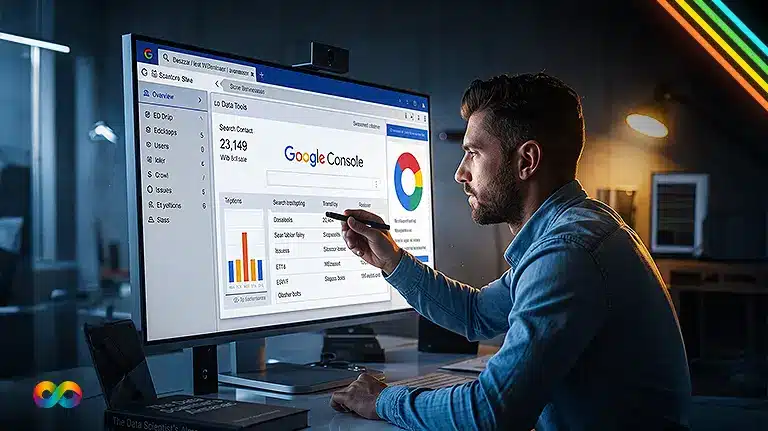


Ask ChatGPT to recommend a marketing agency in Mississauga, a dentist in Brampton, or the best CRM for a small trucking company, and it answers with names. Specific businesses, described confidently, in a single response most people never scroll past. Generative Engine Optimization (GEO) is the discipline of making sure one of those names is yours.
Here is the plainest definition we can give: GEO is the practice of earning citations and mentions inside AI-generated answers, the way SEO is the practice of earning rankings inside search results. The generative engines are ChatGPT, Google’s AI Overviews and AI Mode, Gemini, Perplexity, Claude, and Copilot, and between them they now answer a meaningful share of the questions your customers used to type into a search box.
We run GEO programs for clients as part of our GEO services, and we practice it on our own agency site, where AI assistants now appear as a real referral source in our analytics. This guide is the full 101: what GEO is, the research behind it, how engines choose who to cite, how it differs from and overlaps with SEO, and a practical playbook you can start this month.
Why GEO Exists: The Numbers Behind the Shift
GEO is not a trend piece; it is a response to measured changes in how people find businesses.
- ChatGPT reached roughly 900 million weekly active users by early 2026, according to OpenAI’s own figures, more than double a year earlier, and Semrush data places it among the most visited websites on the planet with over 5 billion monthly visits
- <cite index=”22-1″>Semrush’s April 2026 research reported that outbound referral traffic from ChatGPT grew 206% during 2025</cite>, and its US traffic was still growing 48% year over year by mid-2026
- The Pew Research Center tracked roughly 69,000 real Google searches and found that when an AI summary appears, users click a traditional result only 8% of the time, versus 15% without one, and click the links inside the summary just 1% of the time (Pew Research Center, 2025)
- <cite index=”25-1″>Gartner’s prediction that traditional search volume would drop about 25% by 2026 is tracking close to actual numbers</cite>, and <cite index=”20-1″>Semrush’s 2026 cross-industry data shows AI-driven visitors converting at 4.4 times the rate of standard organic visitors</cite>
- Semrush projects AI-search visitors will overtake traditional search visitors by 2028
Read those together and the strategic picture is clear: fewer clicks are being distributed by traditional results, the answers themselves are becoming the battleground, and the visitors who do arrive from AI surfaces are dramatically more ready to buy. A small stream of high-intent visitors who were personally recommended to you by an assistant is not a consolation prize; on the conversion data, it is often the best traffic a business gets.
GEO vs SEO: The Same Family, a Different Sport
The disciplines are related, and GEO builds on an SEO foundation, but the object of optimization is different, and that changes the work.
| SEO | GEO | |
|---|---|---|
| You are optimizing for | A ranked list of links | A synthesized answer that cites sources |
| The unit of success | Position on the page | Being mentioned or cited in the response |
| Primary judge | Google’s ranking systems | The retrieval and generation behaviour of multiple AI engines |
| Query style | Short keywords (“dentist mississauga”) | Conversational, specific, comparative (“who is the best dentist in Mississauga for nervous patients”) |
| Winner-take structure | Ten-plus results share the page | One answer, typically citing a handful of sources |
| Content that wins | Comprehensive, keyword-mapped, well-linked pages | Clear, well-structured, fact-dense, quotable pages plus third-party corroboration |
| Where authority lives | Backlinks, domain history, content depth | Entity clarity, consistent facts across the web, earned media, structured data |
| Measurement | Rankings, clicks, Search Console | Citation tracking, AI referral traffic, assistant testing |
The overlap matters as much as the differences: engines retrieve from search indexes, so pages that rank are disproportionately available to be cited, which is why GEO without SEO is a house without a foundation. But ranking alone does not get you cited, and that gap is where GEO earns its name. Our full comparison across all three disciplines, including AEO, is in SEO vs AEO vs GEO.
The Research: What Actually Makes AI Engines Cite a Source
GEO has something young disciplines rarely have: peer-reviewed evidence. The foundational study, “GEO: Generative Engine Optimization” by Aggarwal et al., published at KDD 2024 by researchers from Princeton, IIT Delhi, Georgia Tech, and the Allen Institute for AI, built a 10,000-query benchmark and tested nine content modification strategies to see which made generative engines more likely to feature a source. The findings are the closest thing GEO has to physics:
What worked:
- Adding citations to credible sources, adding statistics, and adding quotations were the standout tactics, with the paper reporting visibility improvements of up to 40% across queries when content included them
- Fluency optimization, simply rewriting for clearer, better-structured prose, produced gains in the range of 28%, meaning readable writing is not a nicety; models parse and attribute clear prose more reliably
- The winning tactics validated on Perplexity, a real deployed engine, where quotation addition improved visibility roughly 22% over baseline
What failed:
- Keyword stuffing performed below the unmodified baseline, around 8 to 10% worse, formally confirming that the oldest SEO trick is not just useless in generative engines but counterproductive
The translation for business owners: AI engines prefer to cite pages that look like evidence. Specific numbers, named sources, attributable quotes, and clean writing are machine-extractable proof; vague claims and keyword soup are not. Notice what this article you are reading is doing, statistics with named sources throughout: that is not decoration, it is the tactic.
One more research finding worth knowing, because it reframes where GEO effort goes: Muck Rack’s 2026 analysis of AI citations found that 84% came from earned editorial coverage in third-party publications rather than brand-owned pages. Your website matters, and what the rest of the internet says about you may matter more.
How Generative Engines Choose Sources: A Plain-English Model
Every engine differs in detail, but the citation pipeline looks broadly like this, and each stage is an optimization surface:
- The model’s trained knowledge. Assistants carry a compressed memory of the public web. Brands with years of consistent, factual presence (site, directories, press, reviews) exist in that memory; brands with thin or contradictory footprints do not. This is the slowest layer to change and the reason GEO rewards patience.
- Live retrieval. For current or specific questions, engines search the web (ChatGPT leans on Bing’s index among others; AI Overviews on Google’s) and read a shortlist of pages. Being retrievable means being indexed, crawlable, fast, and ranking at least respectably, which is why your SEO still carries the ticket price.
- Extraction and synthesis. From the shortlist, the model pulls the passages that answer the question and cites the sources it leaned on. This is where the Princeton findings bite: fact-dense, well-structured, clearly attributed content gets extracted; foggy content gets skipped even when it ranks.
- Corroboration. Models weigh agreement across sources. A claim that appears consistently, on your site, in directories, in press, in reviews, reads as fact; a claim that appears only in your own marketing reads as marketing. Entity consistency (same name, address, services, and descriptions everywhere) is the quiet workhorse of GEO.
The GEO Playbook: Where We Start With Clients
This is the sequence we run in real engagements, ordered by leverage.
1. Fix the entity. One canonical description of who you are, what you do, and where, deployed consistently: site, Google Business Profile, LinkedIn, directories, schema markup (Organization, LocalBusiness, Service). If the engines cannot resolve your identity cleanly, nothing downstream compounds.
2. Make your money pages citation-worthy. Apply the Princeton findings mechanically: add real statistics with named sources, quotable one-line answers near the top, expert attribution, and structured headings that mirror the questions customers ask. Our answer engine optimization work is largely this, page by page.
3. Publish evidence, not adjectives. Case studies with numbers are the most extractable content a business can own. “219 new patients at $25.87 per lead” is a sentence an AI can safely repeat; “amazing results for our clients” is not. This is why we publish our client numbers, and it is also why they show up when assistants are asked about us.
4. Earn third-party presence. Given that the large majority of AI citations point to earned media, the work includes listicles and roundups in your category, industry publications, local press, and credible directories. When an assistant answers “best X in Y,” it is very often synthesizing exactly those pages.
5. Keep answering real questions in public. FAQ content, comparison pages, and honest pricing guides map one-to-one onto conversational queries. Our own pricing series exists partly for this reason: assistants asked about Canadian marketing costs have clean, specific, sourced pages to draw on.
6. Stay technically open. AI crawlers (GPTBot, Google-Extended, PerplexityBot, ClaudeBot) must be able to reach you; blocking them in robots.txt is opting out of the channel. Fast pages, clean HTML, and schema help extraction the same way they help Google.
7. Measure like it is a channel, because it is. Segment AI referrals in GA4, test a fixed set of prompts across engines monthly, and track which pages earn citations. What gets measured gets budgeted.
What We See in Our Own Data
EEAT works both ways, so here is our first-hand experience rather than industry averages. ChatGPT and other AI assistants appear as named referral sources in our own GA4, sending [FILL: monthly sessions figure] visits per month as of [FILL: month], up from effectively zero in [FILL: baseline period], and those sessions include real enquiries for our services. On the visibility side, our own pages have been cited in AI answers for queries in our category, and we published a same-week guide when Google shipped its newest AI surface (how to rank on Ask Maps) precisely because early, specific, well-sourced coverage is what engines reach for when a topic is young. None of this makes us unusual; it makes the channel real, and small enough that early movers in any local category can still own it.
A Worked Example: How a Local Business Becomes the Answer
Abstractions hide the work, so here is the shape of a real engagement, using the pattern from our veterinary clients. A clinic starts invisible to assistants: ask “best emergency vet near Mississauga” and the engines name competitors or nobody. The program runs in layers. Entity first: one canonical description, consistent across the site, Google Business Profile, and every directory, plus LocalBusiness and Service schema so machines read the facts without inference. Evidence second: service pages rebuilt with specifics (conditions treated, response times, real pricing ranges) and the case study published with numbers, the way our Innovovet case study documents 3,000+ monthly organic visitors and 1,700+ ranking keywords, and PetCare Partners documents 13,600+ monthly visitors and a 51% share of local search traffic. Corroboration third: reviews accumulating on the profile, mentions in local roundups, consistent NAP everywhere. Months later, the ranking gains arrive first (that is the SEO layer paying out), and then the quieter win: the clinic starts appearing inside AI answers for the conversational versions of those searches, because it is now the best-evidenced, most consistently described entity in its category and city. Nothing in that sequence is magic; it is the Princeton findings plus entity hygiene, applied with patience.
The 5 Query Types Where Assistants Recommend Businesses
Not every prompt can cite you; knowing which ones can tells you what to publish.
- Recommendation queries. “Best dental marketing agency in Canada.” Engines synthesize listicles, reviews, and directories, which is why earned third-party presence dominates here.
- Comparison queries. “WordPress or Shopify for a small store?” Honest comparison content with clear criteria is heavily cited; our own comparison guides exist to be exactly that source.
- Cost and feasibility queries. “How much does SEO cost in Canada?” Transparent, sourced pricing content wins these, and businesses that hide pricing are simply absent from the answer.
- How-to and diagnostic queries. “Why is my Google Ads budget disappearing?” Step-structured, specific guides get extracted, often with the brand named as the source.
- Local intent queries. “Physiotherapist near me who treats runners.” Here the Google Business Profile, reviews, and local pages do the talking, which makes local SEO the GEO entry point for neighbourhood businesses.
Map your content plan against these five and GEO stops being abstract: every page you publish is aimed at a query type an engine actually answers with names.
The Honest Caveats
GEO deserves the skepticism every young discipline deserves, so here is what a trustworthy provider will tell you. AI referral traffic is still a small share of total web traffic for most businesses, around 1% by Search Engine Land’s estimate, so GEO complements SEO and ads; it does not replace them this year. Measurement is genuinely harder than SEO: engines personalize, answers vary run to run, and no Search Console equivalent exists yet, so progress is tracked through referral data, systematic prompt testing, and citation monitoring rather than a single dashboard. The engine market itself is moving: Similarweb’s 2026 data shows ChatGPT’s share of generative-AI traffic falling from roughly 76% to around 53% in a year as Gemini and Claude grow, which is why we optimize for citation-worthiness in general rather than chasing one engine’s quirks. And anyone guaranteeing “#1 in ChatGPT” is selling something the technology cannot promise; what the research supports is systematically increasing your probability of citation, which is exactly what the 40% figure in the Princeton study measures.
Where GEO Fits in Your Budget
For most Canadian small businesses, GEO is not a separate line item yet; it is a lens applied to work you should be doing anyway. Entity cleanup, structured data, statistics-rich content, case studies, and earned mentions all strengthen classic SEO and conversion at the same time, which is why we fold GEO into modern SEO engagements rather than selling it as a mystery add-on. The businesses that should weight it heavily now: anyone in a category where customers ask assistants for recommendations (local services, software, B2B vendors), anyone whose competitors are not yet cited (first-mover citations tend to stick through corroboration), and anyone already ranking well, because they are one optimization layer away from being the answer instead of merely a result. For a market scan of who is doing this work in Canada, we published Top 5 AI Search Optimization (GEO) Companies in Canada, and yes, the methodology and our inclusion are both disclosed in it.
Frequently Asked Questions
Generative Engine Optimization: the practice of improving how often and how favourably AI assistants and AI search features mention or cite your business in their generated answers.
No, it is layering on top of it. Engines retrieve heavily from search indexes, so SEO determines whether you are available to cite, and GEO determines whether you get chosen. Businesses need both, in that order.
They are siblings with different targets: AEO (Answer Engine Optimization) aims at extracted answers in features like featured snippets and AI Overviews; GEO aims at citations inside fully generated responses in assistants. In practice the tactics overlap heavily, and we run them as one program; the distinctions are mapped in SEO vs AEO vs GEO.
Retrieval-layer wins (being cited for current, specific queries) can appear within weeks of publishing citation-worthy content that ranks. Knowledge-layer presence (being recommended from the model's trained memory) builds over months of consistent entity signals and earned coverage. Plan quarters, not days.
It is measurable, just differently: AI referral segments in analytics, monthly prompt testing across a fixed query set, citation tracking tools, and lead-source attribution ("how did you hear about us" now includes "ChatGPT told me" more often than most owners expect).
It protects it from being used, including being recommended. For publishers monetizing content, blocking may be rational; for businesses that want customers, blocking GPTBot and its peers is declining the referral before it is offered.
Fact-dense pages engines can safely repeat: statistics with named sources, transparent pricing, case studies with numbers, honest comparisons, and clear FAQ answers. The Princeton research quantified it: citations, statistics, and quotations lifted visibility up to 40%, while keyword stuffing hurt.
Substantially. Engines corroborate claims across independent sources, and third-party pages dominate citations, so consistent reviews, profiles, and mentions function as the "backlinks" of the generative era.
Arguably more for local: assistant queries like "best physiotherapist near me for runners" have thin competition today, and a well-evidenced local business can become the consistently cited answer in its category while national brands fight over generic terms.
Ask ChatGPT, Gemini, and Perplexity the five questions your customers would ask before hiring you, and record who gets named. That baseline, uncomfortable or not, is your GEO starting line, and it is exactly how we begin every GEO engagement.