
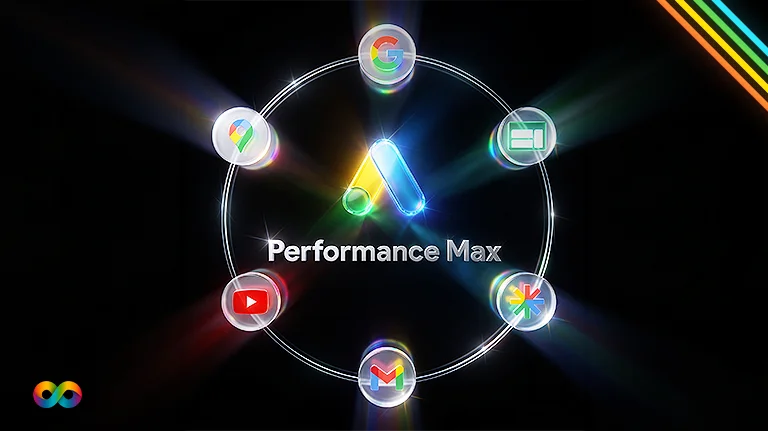

Performance Max is Google’s everything-everywhere campaign type: one campaign that can show your ads across Search, Shopping, YouTube, Display, Gmail, Discover, and Maps, with Google’s machine deciding who sees what, where, and at what bid. You hand it assets and a goal; it hands you results and, famously, not much explanation.
That trade is the whole story of PMax: remarkable reach and automation in exchange for reduced visibility and control. Run well, it is a genuine growth engine, especially for eCommerce. Run naively, it is the fastest way in Google Ads to spend confidently on things you cannot see. This guide explains how it actually works, when to use it and when not to, and the specific controls that keep the machine honest.
How Performance Max Actually Works
You do not pick keywords or placements. Instead you provide three things: a conversion goal (with values if possible), asset groups (headlines, descriptions, images, video, and audience signals), and a budget with a bidding target. Google’s systems then assemble ads on the fly and chase your goal across every surface it owns, per Google’s own PMax documentation. The machine learns from your conversion data, which leads to the first plain-English rule: PMax is only as smart as the conversions you feed it. Garbage tracking in, confident garbage out.
When PMax Is the Right Tool
- eCommerce with a product feed. This is PMax’s home turf; paired with a clean Merchant Center feed it functions as Shopping’s ambitious successor and finds buyers Search alone misses.
- Accounts with solid conversion volume. The machine needs food: as a working floor, expect it to flounder below roughly 30 conversions a month and hit stride above that.
- Scaling past a maxed-out Search campaign. When exact-match demand is fully captured and profitable, PMax is the structured way to buy incremental reach.
- Lead gen, cautiously, with strict lead quality controls. It can work for service businesses, but only with the guardrails below; the machine will happily optimize toward cheap, junk form-fills if junk is what converts easiest.
When PMax Is the Wrong Tool
Skip or postpone it if the account is brand new with no conversion history (run Search campaigns first and bank data), if your budget is small enough that one campaign must be fully accountable, if lead quality matters more than lead volume and you cannot yet measure quality, or if you need to know precisely where every dollar shows. PMax reports outcomes generously and placements grudgingly; businesses that require the second should not pretend otherwise. If you decide to test it, see our Performance Max campaign management page (or our Display and YouTube ads service if you want those placements on their own), and check our list of Google Ads mistakes for common budget leaks first.
Setting Up Asset Groups Properly
Asset groups are PMax’s ad groups: bundles of creative plus audience signal. The practical rules:
- One asset group per theme, not per whim. Segment by product line, service, or audience (implants vs whitening; residential vs commercial), so the machine assembles coherent ads.
- Max out the assets, deliberately. Full headline and description counts, real photography over stock, and video if at all possible; where you provide no video, Google generates one, and you will not love it.
- Audience signals are suggestions, not targeting. Feed your best hints (customer lists, converters, in-market segments), knowing Google treats them as a starting point and will expand beyond them.
- Final URL expansion: decide, do not default. Left on, Google sends traffic to pages it chooses across your site; either turn it off or exclude the pages that should never receive paid traffic (careers, blog archives, the contact page for job seekers).
The Controls That Stop Wasted Spend
This is the section that pays for the article. PMax’s defaults favour spend; these settings favour you.
- Feed it real conversions, valued. Import qualified-lead or purchase values so the machine chases revenue, not raw form-fills. For lead gen, offline conversion import (marking which leads became customers) is the single strongest quality lever.
- Add negative keywords at the account and campaign level. Brand exclusions and junk terms can and should be blocked; ask Google support to apply campaign-level negative lists where the interface resists.
- Exclude your own brand traffic if incrementality matters. Unchecked, PMax will happily “win” the customers who were already typing your name, and the reports will look wonderful.
- Review the placement and search-insight reports monthly. Visibility is limited but not zero: insights pages, search themes and category reports, and placement reports show enough to catch drift.
- Set the campaign a fair budget, then hold it steady. PMax relearns on every big change; whipsawing budgets keeps it in permanent kindergarten. Adjust in 20 to 30% steps.
- Watch it beside your Search campaigns, not instead of them. Healthy accounts run brand and exact-match Search alongside PMax; if PMax starts cannibalizing them, tighten exclusions rather than celebrating its numbers.
PMax vs Standard Shopping: The eCommerce Question
Store owners ask this weekly, so plainly: Standard Shopping gives you query visibility, bid control by product group, and predictable behaviour; PMax adds every other Google surface, creative automation, and typically more volume, at the cost of that control. The pattern that works for many Canadian stores is not either-or but sequence: prove the feed and margins on Standard Shopping (or a tightly watched PMax with brand excluded), then let PMax scale the winners while a Standard campaign guards specific hero products or margin-sensitive lines. Feed quality decides more than campaign type: titles with the words buyers search, correct GTINs, competitive prices, and clean availability data move results on either. A store whose feed is an afterthought will be disappointed by both and blame the campaign type.
The Pre-Launch Checklist
Run this before the campaign goes live, in order: conversion actions verified and valued (offline import planned for lead gen); Merchant Center feed clean, if eCommerce; asset groups themed, with full text assets, real images, and video supplied; audience signals loaded from your best customer data; brand terms excluded where incrementality matters; account-level negatives applied; URL expansion decided and fenced; budget set at a level you can hold steady for six weeks; a monthly reminder created for placement and search-insight reviews; and agreement, in writing if an agency runs it, on which blended numbers judge success. Ten minutes of checklist against weeks of confident misspending is the best trade in this campaign type.
Reading PMax Results Honestly
Judge PMax on blended account performance, not its own scoreboard. Its self-reported cost per conversion can look better than every other campaign precisely because it grabs the easiest conversions, including branded ones. The honest questions each month: did total account conversions rise after PMax launched, at what blended cost, and are the leads it produces closing? For a store, tie it to revenue and margin by product line. For lead gen, tie it to qualified rate. Those numbers survive automation bias; campaign-level vanity does not.
Frequently Asked Questions
Different jobs. Search gives control and transparency on high-intent queries; PMax buys automated reach across surfaces Search cannot touch. Mature accounts usually run both, with Search holding the money keywords and PMax scaling around them.
Expect volatility for 2 to 6 weeks after launch or after major edits, longer at low conversion volume. Judge trends at 30-day windows, and resist daily surgery; every big change restarts part of the clock.
Enough to buy roughly 30+ conversions a month at your expected cost per lead or sale; below that the machine starves. Many Canadian small accounts do better spending that same budget on tight Search campaigns first, then graduating.
Because everything-everywhere includes the weird parts. Placement exclusions, tighter asset groups, and turning off or fencing URL expansion pull it back; monthly placement reviews keep it back.
Yes, with the lead-quality guardrails: valued conversions, offline import, aggressive negatives, and honest blended measurement. If that sounds like more machinery than you want to run, that is fair, and it is exactly the setup work our Performance Max management exists to do.
No. PMax is a powerful component, not a strategy. Accounts that are 100% PMax have outsourced both their targeting and their accountability to the same machine, and machines do not attend your revenue meetings.