



Quality Score is Google’s rating of how relevant and useful your ad, keyword, and landing page are compared to other advertisers, scored from 1 to 10 at the keyword level, according to Google’s own Quality Score documentation. It directly affects two things that matter to your bottom line: where your ad ranks, and how much you pay per click. Two advertisers can bid the identical amount on the same keyword and end up paying meaningfully different prices per click, purely because one has a stronger Quality Score than the other.
Why Quality Score actually matters
- Ad rank: a higher Quality Score helps your ads rank above competitors, even against a higher raw bid, meaning a well-optimized account can outrank a bigger budget that’s poorly targeted.
- Cost per click: advertisers with strong Quality Scores pay less per click than competitors bidding on the same keyword with a weaker score. A poor score means paying more for the same position, or losing it entirely to a competitor willing to pay the premium.
- Google’s own incentive: Google rewards relevant, useful ads because it protects the search experience for users, which is ultimately what keeps people using Google Search at all, and by extension what keeps advertisers able to reach them.
What actually lowers your Quality Score
Click-through rate. This is the single strongest signal in the score. Google tracks how often people click your ad relative to how often it’s shown, and a strong historical CTR is treated as real evidence the ad is relevant to the search, not just well-written in isolation. An ad that looks polished but rarely gets clicked tells Google something isn’t matching, regardless of how it reads to you.
Relevancy. Your ad copy needs to closely match what people are actually searching for. An ad for “drinking bottles” showing against a search for “copper water bottles” reads as a mismatch to Google, even if the products overlap conceptually, and gets scored accordingly. The more specific and literal the match between search term and ad copy, the better this factor performs.
Landing page experience. Bounce rate and site speed both factor in here. A landing page that loads slowly or fails to deliver what the ad promised drags the score down even when the ad itself is well-written and well-targeted. Sending traffic from a specific, well-targeted ad to a generic homepage is one of the most common, most avoidable ways this factor gets dragged down.
How to actually improve it
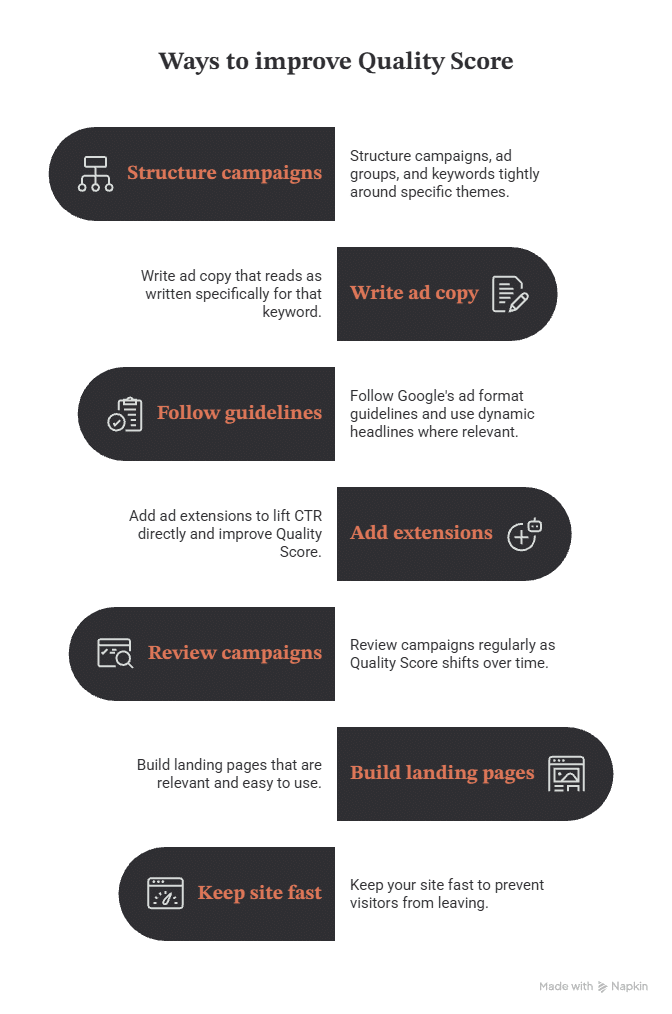
- Structure campaigns, ad groups, and keywords tightly around specific themes rather than broad, mixed targeting, a single ad group covering ten unrelated products will always underperform ten focused ad groups
- Write ad copy that reads as written specifically for that keyword, not generic or visibly AI-generated boilerplate
- Follow Google’s ad format guidelines and use dynamic headlines where relevant
- Add ad extensions, they lift CTR directly, which improves Quality Score as a secondary effect, and they cost nothing extra to add
- Review campaigns regularly rather than setting them up once and leaving them, Quality Score shifts over time as competition and search behavior change
- Build landing pages that are actually relevant and easy to use once a visitor arrives, matching the specific offer or product the ad promised
- Keep your site fast, a slow-loading landing page pushes visitors to a competitor before they see anything else, no matter how well the ad itself performed
How to check your Quality Score
- In your Google Ads account, select the Campaigns icon
- Go to Audiences, keywords, and content
- Select Search keywords
- Click the columns icon in the upper right of the table
- Under “Modify columns for keywords,” open the dropdown next to “All columns”
- Navigate to the Quality Score section and add the relevant columns
Checking this regularly, not just once during setup, is what actually lets you catch a declining score before it meaningfully raises your cost per click.
Real proof: what a strong Quality Score actually produces
Quality Score isn’t an abstract metric, it shows up directly in cost per lead. Our Coachella Valley VW campaign generated 276 phone leads at $9.12 per lead, a CPL well below typical automotive industry benchmarks, built on tightly themed ad groups and landing pages matched precisely to search intent, exactly the fundamentals that drive Quality Score up. Popular Pizza’s campaign achieved 363 conversions at just $1.44 each, the kind of cost efficiency that’s difficult to reach without a genuinely strong account-wide Quality Score keeping cost per click down across every keyword.
Both campaigns share the same underlying discipline: ad groups built around specific, tightly related keywords rather than broad catch-all targeting, and a landing page built to match exactly what the ad promised, not a generic homepage redirect. That combination is what actually moves Quality Score, not any single trick applied in isolation.
Putting it together
Quality Score determines both your ad ranking and what you pay to get there, which makes it one of the highest-leverage things to manage in any Google Ads account. Our Google Search Ads (PPC) service is built around exactly this discipline, tight campaign structure, relevant copy, and landing pages that actually deliver on what the ad promises.