






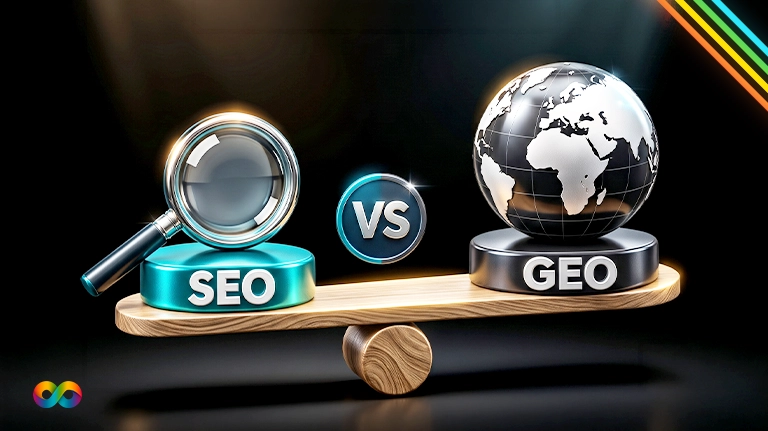

If you have done SEO for more than a few years, you have probably noticed the job feels different. The rankings still matter. The reports look the same. But the clicks behind them do not add up the way they used to.
Most businesses respond in one of two ways. Some panic and rebuild everything “for AI.” Others ignore the shift completely. Both cost money.
This post looks at GEO vs traditional SEO from the inside: what actually changed between classic search optimization and generative engine optimization, what stayed exactly the same, and what to keep, stop and start. We changed how we report on SEO for our own clients this year, so this is the practical version.
The Short Answer: What Changed?
Traditional SEO earns a ranked link. Generative engine optimization (GEO) earns a mention or citation inside an AI-generated answer. What changed is where the answer appears, how success is measured and what kind of content gets picked. What did not change is the foundation: Google says its AI features are “rooted in our core Search ranking and quality systems.”
That line comes from Google’s own AI optimization guide, and it shapes everything below. For a full side-by-side of the disciplines, see SEO vs AEO vs GEO. For the basics, start with What Is GEO?
How Search Changed: A Short Timeline
| When | What changed |
|---|---|
| 2010s | Ten blue links; clicks spread down the page |
| Late 2022 | ChatGPT launches, and assistants start answering questions directly |
| 2024 | Google’s AI Overviews roll out widely; the Princeton-led GEO paper gives the discipline its name |
| 2025 | Pew Research Center measures fewer clicks when an AI summary appears |
| June 3, 2026 | Google announces AI performance reports in Search Console |
| July 2026 | Google updates its AI optimization guide, spelling out what you do and don’t need |
| Aug 31, 2026 | Search Console AI reports reach every site worldwide |
The last three rows are why this matters now. In a single summer, Google started telling site owners how its AI search works and started showing them the data.
Seven Things That Changed
1. The Answer Sits Above the Links
Then: ten blue links. Now: an AI-written answer at the top that can satisfy the searcher before they scroll.
The click cost is measurable. Pew found people clicked a traditional result 8% of the time when an AI summary appeared, against 15% when one did not. Only 1% clicked a link inside the summary itself. Ranking still gets you on the page, but the page now has a new first stop.
2. Being Named Matters as Much as Ranking
Then: success was a position from 1 to 10. Now: success also means being cited or named inside the answer.
A page can rank fourth and still be the source an AI Overview quotes. It can also rank first and never be cited. That gap between ranking and being named is the space our GEO services work in.
3. Queries Got Longer and Wider
Then: short keywords like “dentist mississauga.” Now: full questions, and Google’s AI features may use what it calls query fan-out, running several related searches behind a single question.
The practical effect: one page can be pulled in for questions it never targeted, as long as it answers a subtopic clearly. Clear sections that each answer one question earn more of those retrievals.
4. Measurement Finally Caught Up
Then: you tracked rankings and clicks, and AI visibility was guesswork. Now: Search Console shows your impressions in AI Overviews, AI Mode and Discover’s AI features, broken down by page, country and date.
Be clear about the limits. The report shows impressions, not clicks, and sites with few AI appearances may not see a report yet. Pair it with a GA4 segment for referrals from ChatGPT, Perplexity and other assistants. If Search Console is not set up, start with our setup guide.
5. Evidence Beats Keywords
Then: keyword targeting and keyword density. Now: original, specific, sourced content gets picked.
The Princeton research found that adding citations, statistics and quotations raised visibility in AI answers by up to 40%, while keyword stuffing did worse than changing nothing. Google’s guide asks for original, non-commodity content with a unique point of view. A sentence like “Get Back Physiotherapy earned 42,000 clicks from 612,000 impressions” is a fact an answer can safely repeat.
6. Authority Moved Off Your Site
Then: backlinks counted as ranking votes. Now: what other credible sites say about you shapes whether AI names you.
Muck Rack’s May 2026 analysis of more than 25 million links found that 84% of citations in ChatGPT, Claude and Gemini came from earned sources such as journalism, research and reference sites. One caution from Google: chasing inauthentic mentions is not helpful.
7. The Click Got Rarer and More Valuable
Then: traffic volume was the goal. Now: there are fewer visits, but people who arrive from an AI recommendation have often already narrowed their choice.
Keep it in proportion. AI referrals are still a small share of traffic for most businesses, so they add to search and ads rather than replace them. Our guide on how to get cited by ChatGPT covers that channel in detail.
What Did Not Change
Google says there are no additional requirements to appear in AI Overviews or AI Mode. A page must be indexed and eligible to show in Search with a snippet, which is ordinary SEO.
According to Google’s July 2026 guide, you do not need:
- An llms.txt file or other AI text files. Google says Google Search itself does not use them.
- Special markup, or Markdown versions of your pages
- Content chopped into small chunks, or any ideal page length
- Pages rewritten in special phrasing, or extra long-tail keywords for AI
- Structured data for AI search specifically (it still helps rich results)
What stays essential is familiar: crawlable pages, a good page experience, minimal duplicate content and, for local businesses, a complete Google Business Profile. Our technical SEO work covers exactly that layer.
One scope note: this is Google’s guidance for Google Search. ChatGPT, Perplexity and others publish far less about how they choose sources, so the safest strategy is content any engine can trust.
Keep, Stop, Start: The Practical Shift
| Keep | Stop | Start |
|---|---|---|
| Technical SEO and crawlability | Keyword stuffing and exact-match anchor spam | Tracking AI impressions in Search Console every month |
| Pages that answer real customer questions | Publishing thin pages at scale | Adding sourced statistics and real numbers to money pages |
| Internal linking | Treating rank position as the only KPI | Segmenting AI referrals in GA4 |
| Google Business Profile and reviews | Paying for llms.txt or “AI-ready” add-ons | Testing a fixed set of customer questions in AI assistants monthly |
| Earning links from real publications | Chasing fake mentions | Publishing case studies with specific results |
| Letting Google and AI crawlers in | Blocking AI crawlers without a reason | Keeping business facts identical across every profile |
Look closely at the “Start” column. Most of it is good SEO done more rigorously, not a separate discipline. That is why our AEO services and GEO work sit on top of SEO rather than beside it. For one surface in depth, see our AI Overviews optimization guide.
How We Changed Our Own SEO Reporting
Our monthly client reports used to open with rankings and organic clicks. This year they gained three new parts:
- AI impressions by page, from the new Search Console report.
- An AI referral segment in GA4, covering ChatGPT, Perplexity, Gemini and Copilot.
- A fixed panel of real customer questions, tested in AI assistants each month with screenshots, so we can see who gets named.
Rankings still lead the report, because Google’s AI features are built on them. What changed is how we read them: a page that ranks and is never cited is now an opportunity, not a finished job.
[FILL: one real figure from our own site, e.g. “Our own site earned X impressions in Google’s AI features in September 2026, according to Search Console.”]
That reporting is part of our SEO reporting and analytics work for every client.
GEO Myths to Ignore
- “SEO is dead.” Google’s AI features use its core ranking systems. SEO is the entry ticket.
- “GEO works in days.” A single fast result is an anecdote, not a pattern. Results vary by category and competition.
- “You need an llms.txt file.” Google says its search does not use one.
- “We guarantee #1 in ChatGPT.” Nobody controls what an AI answer says. Anyone promising this is guessing.
- “Our tool sees Google’s AI rankings.” Google states that third-party tools have no access to its internal AI systems.
Frequently Asked Questions
Yes. Google's AI features rely on its core ranking systems, and a page must be indexed and eligible for a snippet before it can appear in them.
Yes. Search Console's generative AI report shows your impressions in AI Overviews, AI Mode and Discover. It does not show clicks yet.
No. Google says Google Search does not use llms.txt or any other AI text file, so it has no effect on your visibility there.
Not in any special phrasing. Make them more specific and better sourced instead. Google says no special rewriting is needed to appear in its AI features.
It is a layer on top of SEO. Most GEO work, such as adding evidence, keeping business facts consistent and earning coverage, strengthens your rankings too.
There is no reliable timeline. Pages that already rank well and add clear, sourced answers usually move first.