


Treating B2B and B2C marketing as the same discipline with a different logo is one of the more common, more costly mistakes a business makes when building out its digital strategy. The buying process, the decision-makers, and the timeline are genuinely different, and a strategy built for one rarely transfers cleanly to the other.
What actually separates B2B from B2C
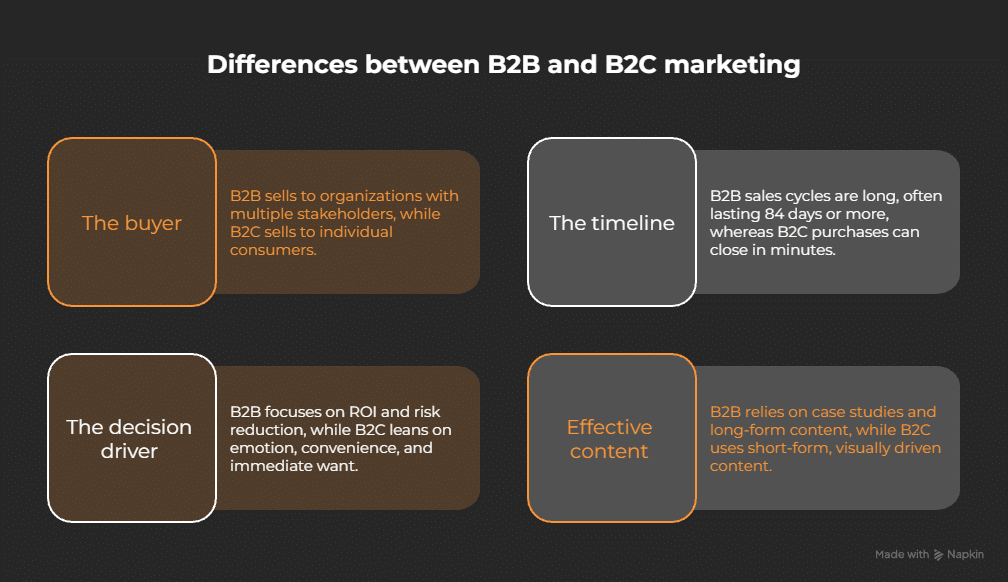
The buyer. B2B marketing sells to organizations, where a purchase typically has to satisfy multiple stakeholders rather than one person’s preference. Recent Forrester and 6sense research puts the average B2B buying committee at 11.2 people for deals over $50,000, up from 9.7 just a couple of years earlier. B2C marketing sells to an individual consumer making a decision largely on their own. That difference alone reshapes almost everything downstream: a B2B campaign has to persuade a finance lead, an end-user department, and often an IT or procurement reviewer simultaneously, while a B2C campaign only has to win over the person actually holding the credit card.
The timeline. B2C purchases can close in minutes for impulse buys or stretch to a few months for considered purchases like furniture or a major appliance. B2B sales cycles run far longer, the median B2B sales cycle now sits at roughly 84 days, and enterprise deals above $250,000 can take 6 months or more from first contact to close. That gap means a B2B campaign has to sustain interest and relevance across months of nurture touches, while a B2C campaign that isn’t converting within days or weeks is usually not going to convert at all.
The decision driver. B2B purchases are evaluated primarily on measurable return on investment and risk reduction, often against a formal business case that has to survive internal scrutiny. B2C purchases lean more heavily on emotion, convenience, and immediate want, even when a rational justification gets layered on afterward. This is why a B2B ad built around emotional brand storytelling alone tends to underperform, and why a B2C ad built entirely around a spreadsheet of ROI projections falls flat.
The content that actually moves a decision. In B2B, comparative evaluation guides, ROI calculators, and case studies are what buying committees actually pass around internally, industry research shows case studies specifically rated the most effective content type by B2B marketers surveyed, and long-form content over 2,000 words generates roughly three times more leads than shorter pieces, even though it draws fewer total views. In B2C, short-form, visually driven content built for a single quick decision performs better than a detailed evaluation guide nobody is looking for.
B2B strategies that actually work
Content built for group consensus, not individual persuasion. A buying committee with more than ten stakeholders needs shared material that helps them agree internally, comparison guides, ROI calculators, and implementation checklists consistently outperform content written to persuade a single reader. Content specifically built to help a champion inside the buying committee make the case to their colleagues, rather than content aimed only at that champion themselves, tends to move faster through a stalled decision.
Case studies with real numbers. We saw this directly with Ace Course, where implementing a full Zoho One CRM system across all 41 available apps, including webform lead capture, custom deal pipelines, and integrated invoicing, gave the client enterprise-level operational capability that became the actual selling point in their own B2B conversations with prospective students and partners. That kind of concrete, specific proof is what a B2B buying committee actually needs to build internal consensus, not general claims about quality.
SEO built around the specific terms a business buyer searches for. SEO strategy for B2B needs to target the specific, often more technical language a business researcher uses, not the broader consumer-facing terms a B2C strategy would chase. A B2B buyer is far more likely to search a specific pain point or technical requirement than a broad category term, and content built around those specific phrases tends to reach genuinely qualified researchers rather than casual browsers.
LinkedIn and direct outreach over broad social reach. B2B decision-makers are reachable in a way broad consumer social platforms don’t replicate well, LinkedIn advertising and targeted email sequences tend to outperform broad organic social for this specific audience. Given how many stakeholders are typically involved, a multi-touch sequence reaching several people within the same target account tends to outperform a single well-targeted ad reaching only one contact.
B2C strategies that actually work
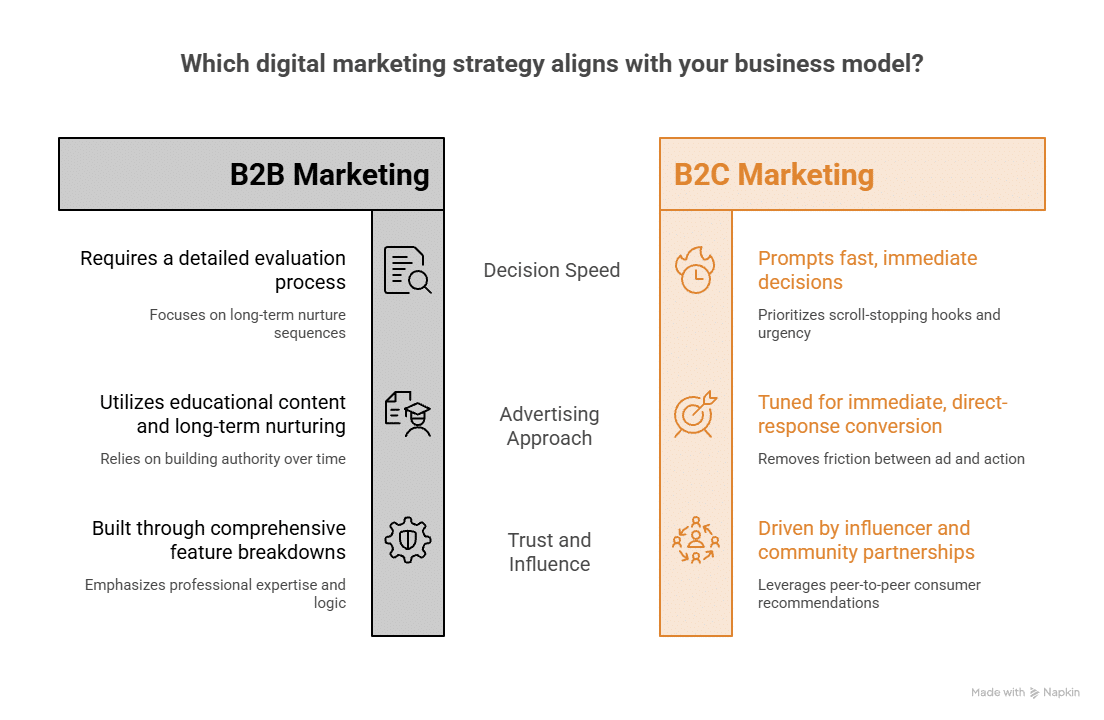
Social media built for scroll-stopping, not evaluation. Consumers make fast decisions, so B2C content needs to grab attention and prompt action within seconds, not walk through a detailed evaluation. A strong hook in the first second of a video or the first line of a caption matters more here than a comprehensive feature breakdown ever will.
Paid campaigns tuned for immediate conversion. We’ve seen this work concretely: our Popular Pizza / Royal West Pizza campaign generated 363 conversions at just $1.44 each, and our Coachella Valley VW campaign drove 276 phone leads at $9.12 per lead, both built around fast, direct-response paid advertising rather than a long nurture sequence. Both campaigns succeeded by removing friction between the ad and the action, a clear offer, an obvious next step, and minimal steps between clicking and converting.
Influencer and community-driven content. Consumers trust other consumers, and a well-matched influencer partnership can move a B2C audience in a way a branded ad alone often can’t. The match matters more than the follower count, an influencer whose existing audience genuinely overlaps with your target customer will usually outperform a larger but less relevant one.
Email built for immediate relevance, not a long nurture cycle. Time-limited offers, seasonal relevance, and personalization based on recent browsing or purchase behavior perform better in B2C than the longer, more educational nurture sequences that work in B2B. A cart-abandonment email sent within hours, not days, is a good example of this urgency-first approach in practice.
How measurement differs between the two
B2B and B2C also diverge sharply in what counts as a meaningful metric. A B2B campaign should be tracked through the full funnel, marketing qualified leads, sales qualified leads, opportunities, and closed deals, since a single top-of-funnel lead number tells you almost nothing about actual pipeline health when the buying group is this large and the cycle this long. A B2C campaign, by contrast, can often be judged much more directly on cost per conversion and return on ad spend within days of launch, since the feedback loop is short enough to react to quickly.
This has a practical implication for how each is managed day to day: B2B campaigns need patience and a willingness to judge success over months, while B2C campaigns should be optimized aggressively and quickly, since a channel or creative that isn’t working will usually show that clearly within the first week or two rather than requiring a long wait to know.
Choosing the right approach for your business
Some businesses genuinely operate in both worlds, a manufacturer selling to retailers (B2B) that also runs a direct-to-consumer storefront (B2C) needs two distinct strategies running in parallel, not one blended approach trying to serve both audiences at once. The starting question is always the same: who is actually making this purchase decision, an individual buying for themselves, or a group evaluating on behalf of an organization, and everything else, content format, channel selection, timeline expectations, and how you measure success, follows from that single answer.