



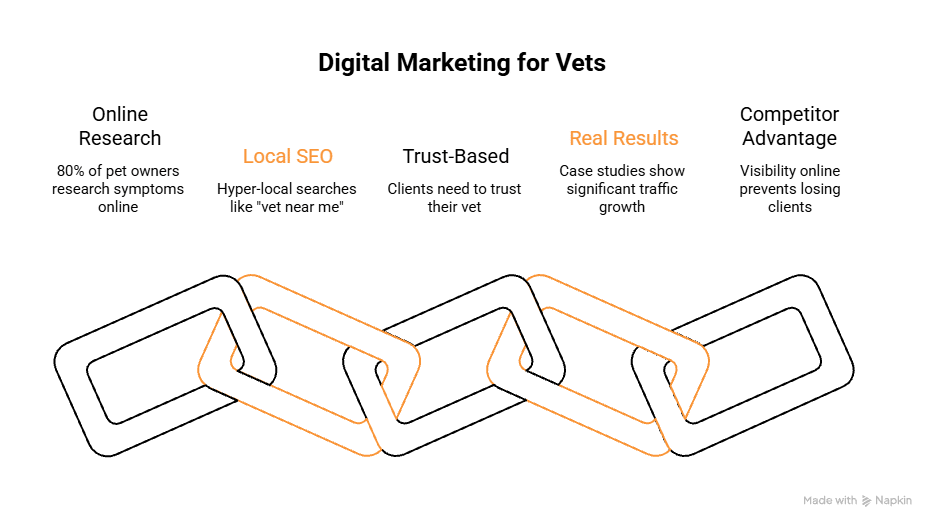
Pet owners are searching online before they ever call your clinic, and increasingly before they even decide whether a vet visit is necessary at all. One recent industry survey found 80% of pet owners now research their pet’s symptoms online before visiting a veterinarian, up from 75% just a year earlier, and a third said their first instinct when a pet shows signs of illness is to search Google or ask an AI assistant directly. If your clinic isn’t visible at that moment, a competitor’s clinic is.
This guide covers what actually works for veterinary marketing specifically, not generic small-business advice with “vet” inserted into it.
Why digital marketing matters more for vets than most local businesses
Veterinary care sits at an unusual intersection: it’s hyper-local (people search “vet near me,” not “best vet in Canada”), it’s trust-based (nobody wants a stranger operating on their family member), and it’s increasingly researched online before a single phone call is made. That combination means a weak digital presence costs you clients who never even reach the point of calling to compare prices, they simply choose whoever showed up first and looked most credible.
Real results, not theory: we’ve seen this play out directly. Our work with Innovovet, a Mississauga veterinary group, grew organic search traffic to 3,000 monthly visitors and reached 92% SERP dominance for their core local service terms within a 10-month campaign. For PetCare Partners, a US-based veterinary client, the same underlying SEO approach grew organic traffic from a standing start to 13,600 monthly visitors, with a 51% traffic share against the top local competitors. Neither of those results came from generic advice, they came from a strategy built specifically around how pet owners actually search.
Local SEO: the foundation everything else depends on
If a veterinary clinic does exactly one thing well, it should be this. Most veterinary searches are local by nature (“emergency vet near me,” “best vet in [city]”), which makes local SEO the highest-leverage channel available, not an optional add-on.
The core pieces:
- Google Business Profile, fully filled out, with accurate hours, services, and photos, kept current especially around holiday hours and emergency availability
- Consistent NAP data (name, address, phone) across your website and every directory you’re listed on, inconsistencies here actively confuse Google’s local ranking algorithm
- Location-specific service pages if you serve multiple areas or have multiple locations, rather than one generic page trying to rank for every city at once
- Review generation, both volume and recency matter for local ranking, and reviews are also the single biggest trust signal a nervous pet owner looks for before booking
We built a full breakdown of this exact approach in our dedicated veterinary SEO service page, including the specific technical and content strategies we use for clinics.
One detail that trips up a lot of multi-doctor or multi-location practices: make sure your Google Business Profile categories and service list actually match what a searching pet owner would type. “Veterinary care” as a single generic category undersells a clinic that also offers dental surgery, emergency care, or exotic animal treatment, each of those is a distinct search intent worth its own visibility.
Social media: showing the human side of your clinic
Social media works differently for vets than for most B2B or retail businesses, it’s less about direct sales and more about building the emotional trust that gets someone to choose your clinic over the one two blocks away. The content that actually performs:
- Patient stories, with owner permission, real before-and-after recoveries build more trust than any ad copy could
- Preventive care education, seasonal hazards, nutrition tips, parasite prevention windows specific to your region
- Behind-the-scenes content, introducing your actual veterinarians and staff by name and face
- User-generated content, encouraging clients to tag your clinic in their own pet photos and reviews
Facebook and Instagram remain the strongest platforms for this specifically because pet owners already use them to share photos of their pets, meeting your audience where the behavior already exists rather than trying to redirect it.
Paid advertising: capturing the moment someone is actually searching
Google Ads and Meta Ads let you show up at the exact moment someone is searching with clear intent, which matters enormously for time-sensitive veterinary situations. A well-targeted campaign for “emergency vet open now” reaching someone at 11pm on a Saturday can be the difference between them finding your clinic or your closed competitor’s outdated Google listing.
What makes vet-specific PPC work:
- Tight geo-targeting, radius-limited to your actual service area, not province-wide
- New client offers, a free first wellness exam is a common, effective way to convert a first-time searcher
- Conversion tracking on calls specifically, not just form fills, since most urgent veterinary inquiries come by phone
Content marketing: answering the questions pet owners are already asking
Every question a pet owner searches before deciding whether to call you, “is it normal for my dog to limp after a walk,” “how often do cats need vaccines”, is an opportunity for your clinic to be the answer they find, provided the content is genuinely useful rather than a thin excuse to mention your clinic name. This same content also increasingly feeds AI systems like ChatGPT and Google’s AI Overviews when they answer pet health questions directly, which is the newer, faster-growing half of this channel.
The clinics that do this well tend to build content around three categories: seasonal concerns specific to their region (heatstroke risk in summer, antifreeze poisoning in winter), breed-specific or age-specific care questions (senior dog joint care, kitten vaccination schedules), and the practical logistics questions that create anxiety before a first visit (what to bring to a first appointment, what a typical wellness exam actually includes). None of this needs to be long-form blog content exclusively, short video answers and simple downloadable checklists often perform just as well and are easier for a busy clinic to produce consistently.
One caution worth naming directly: content that reads as generic, AI-drafted filler without real veterinary specificity tends to underperform both with readers and with search engines, which increasingly reward genuinely differentiated, expert-reviewed content over generic advice that could apply to any clinic anywhere.
Email marketing: the channel that keeps clients coming back
Client retention matters as much as acquisition, and email is still the most direct, cost-effective way to stay present between visits:
- Automated reminders for annual checkups, vaccinations, and dental cleanings, reducing the no-show and lapsed-client problem every clinic deals with
- Seasonal newsletters with practical care tips relevant to the time of year
- Milestone messages, a pet’s adoption anniversary or birthday is a small touch that meaningfully strengthens the client relationship
Segment your list where possible. A client whose pet is due for a senior wellness panel needs a different message than a client who just adopted a puppy, and generic blast emails to an entire client list tend to underperform compared to even basic segmentation by pet age or last visit date.
What this should cost, and how to measure it
Most veterinary clinics should budget somewhere between 3 and 10% of annual revenue for marketing, with newer or growth-focused clinics trending toward the higher end. Track these specifically, not just general website traffic:
- Appointment bookings and calls attributable to specific campaigns
- Google Business Profile views and direction requests
- Review count and average rating trend over time
- Cost per new client acquired, broken down by channel