







Air Canada’s website chatbot once told a grieving customer he could apply for a bereavement discount after his trip. He could not. When he took the airline to a tribunal, Air Canada argued it was not responsible for what its chatbot had said.
It lost.
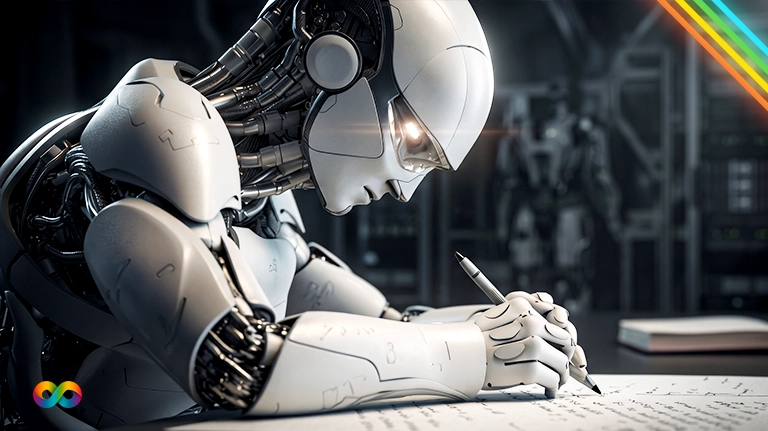
AI can write. What it cannot do is be accountable for what it writes. Every word on your website, in your ads and in your emails is your claim, whoever or whatever drafted it. This guide covers what AI copywriting does well, the six jobs human writers still own, and how to split the work between them. We use AI in our content work every day, and a person signs off on every word that goes out.
Can AI Replace Copywriters? The Short Answer
No, but it has replaced parts of the job. AI copywriting is fast and useful for ideas, first drafts and variations. It still cannot verify facts, take responsibility for claims, bring first-hand experience or know your customers. The writers who thrive now direct AI and own the final word.
That changes the question. It is no longer “AI or human?” It is “which parts of the job go where?” Get that split right and you get speed without the risk. Get it wrong and you publish a confident, polished copy that nobody actually checked.
What AI Copywriting Does Well
Start by giving AI its due. For several tasks, it is faster than any writer, and pretending otherwise wastes time.
| AI is good at | What still needs a human |
|---|---|
| Brainstorming 20 headline or subject-line ideas in seconds | Choosing the one that fits the brand and the offer |
| A first draft from a clear brief | The facts, examples and opinions readers come for |
| Ad copy variations for testing | Checking claims, character limits and ad policies |
| Repurposing one article into social posts | Making sure nothing was exaggerated in the shortening |
| Summarising long documents, reviews or transcripts | Deciding what the summary means for the business |
| Fixing grammar and tightening sentences | Keeping the voice from going flat |
Search engines are not the obstacle either. Google’s guidance says generative AI can help with research and structure, as long as site owners fact-check and review what it produces before publishing. For more ideas, see our list of AI use cases in digital marketing.
Six Jobs Human Writers Still Own
1. Being Accountable for Every Claim
In Moffatt v. Air Canada, decided in February 2024, British Columbia’s Civil Resolution Tribunal held the airline responsible for all the information on its website, whether it came from a static page or a chatbot. Air Canada’s argument that the chatbot was responsible for its own words was, in the tribunal’s phrase, “a remarkable submission.” The airline was ordered to pay $812.02.
The dollar amount was small. The principle was not. If AI writes it and you publish it, you said it, and you are the one who answers for it.
2. Keeping Claims Legal
Canada’s Competition Bureau judges marketing claims using a general impression test: what a claim literally says, and the overall impression it leaves. A claim that is partly true, or technically true but misleading in context, can still break the rules.
AI writes persuasive generalities with ease. “The fastest service in the GTA.” “Guaranteed results.” It has no idea whether you can prove them. Regulated sectors such as dental, legal, financial and health care add their own rules on top, and a person has to know them. This is general information, not legal advice.
3. Bringing First-Hand Experience
AI can only remix what already exists. Google’s AI optimization guide asks for original, non-commodity content with a unique point of view, which is exactly what a model working alone cannot supply.
Compare two sentences. “We generated hundreds of leads at a low cost.” Versus: “Landmark Real Estate received 452 leads at $19 each.” The first could be on any agency’s website. Only someone with the real data could write the second, and it is the one that earns trust.
4. Knowing the Customer
The best copy uses the customer’s own words: the phrases they use on sales calls, in reviews and in complaints. Those words rarely appear in a prompt.
AI has never answered your phone. A writer who listens to five real customer calls will usually write a sharper headline than any prompt, because they know which worry to answer first.
5. Holding a Brand Voice
Left alone, AI defaults to a polished, middle-of-the-road tone. Without examples and a style guide, every brand starts to sound like every other brand.
A human editor keeps your voice consistent across the website, ads, emails and proposals, which is part of what makes a business recognisable. It is also one of the first things we define in our branding work.
6. Earning Trust People Can See
Readers are paying attention. In a Pew Research Center survey of more than 5,000 US adults in 2025, 76% said it is extremely or very important to be able to tell whether text, images or video were made by AI or by people. And 53% were not confident they could tell.
That gap is your opportunity. Named authors, real examples and specific numbers are signals that a person stands behind the words.
How to Split the Work: AI vs Human by Copy Type
| Copy type | AI’s role | Human’s role |
|---|---|---|
| Blog posts and guides | Outline, first draft, structure | Research, first-hand examples, facts, final edit |
| Service and landing pages | Variations of sections | Positioning, claims, proof, compliance |
| Google and Meta ads | Many headline and description options | Picking, checking limits, policy and claim review |
| Emails and newsletters | Subject line ideas, first draft | Voice, offer accuracy, personal touches |
| Social captions | Repurposing longer content | Tone, timing, replies to real people |
| Case studies and testimonials | Formatting only | Everything else: never let AI invent results or quotes |
The rule of thumb is simple. The higher the stakes and the more specific the claim, the more the human owns. Ads are a good example: AI can produce 30 headlines in a minute, but a person still has to catch the ones that break a policy or promise too much, a theme in our list of Google Ads mistakes.
A Human-Led AI Copywriting Workflow
Treat AI as one step in an editing process, not the whole process. We run every AI draft through six passes:
- The brief pass (human). Define the audience, the offer, the proof points and the one action you want. AI is only as good as this.
- The draft pass (AI). Ask for two or three different angles rather than one, so there is something to choose between.
- The fact pass (human). Check every number, name, date and promise against a source.
- The claims pass (human). Read it as a sceptical customer would, and as the Competition Bureau would: could the overall impression mislead?
- The voice pass (human). Rewrite anything that sounds like everyone else, and add one real example only you could give.
- The read-aloud pass (human). If you would not say it to a customer’s face, cut it.
[FILL (optional): one anonymized example of the fact or claims pass catching an AI error before publishing. Delete this line if not used.]
The same discipline sits behind every page we write as part of our SEO services.
Signs Your Copy Went Out Without a Human Edit
There is no reliable list of “AI words,” so ignore anyone selling one. These editorial red flags are more useful, whoever wrote the draft:
- Claims with no number, name or source behind them
- Superlatives you could not prove, such as “the best” or “guaranteed”
- Paragraphs that would fit any competitor’s website unchanged
- Statistics with no link, or a link that does not say what the copy claims
- Customer quotes or results nobody can trace to a real customer
- A tone that does not match your other pages, emails or ads
Two or more ticks means it is time for an editor, not a better prompt.
What This Means for Copywriters
The job is moving from typing to directing. Good copywriters now spend less time producing first drafts and more time writing sharp briefs, checking harder and adding what AI cannot: interviews, data, judgement and taste.
The skills that matter more than ever are research, customer interviews, editing, claim checking and knowing a sector’s rules. A writer who uses AI well will out-produce a writer who refuses to use it. But AI on its own will not replace either of them.
The Bottom Line
AI copywriting is a fast, capable first draft, and pretending otherwise wastes time and money. But a draft is not a decision. Every claim still needs someone who checked it, can prove it and will stand behind it, as Air Canada learned in front of a tribunal. Let AI do the typing. Keep a human responsible for the truth, the voice and the customer, because that is the part your reputation depends on.
Want a second pair of eyes? Send us one page for a free copy review, and we will show you which claims need proof, where the voice goes flat and what only you can add. We work month to month, with no contract.
Frequently Asked Questions
Not entirely. AI has taken over much of the drafting and variation work, but someone still has to verify facts, own the claims and bring real experience to the page.
Not by itself. Google allows AI-assisted content and asks for fact-checking, while mass-produced pages that add no value break its spam policies.
The business that publishes it. In 2024, a Canadian tribunal held Air Canada responsible for wrong information its website chatbot gave a customer.
No. Reviews must come from real customers. Invented ones are misleading, and Canada's Competition Act prohibits misleading marketing claims.
Give real examples of your writing and a short style guide, then have a person edit every piece for voice before it goes out.
Many readers want to know. Either way, a named author and clear editorial responsibility do more for trust than any disclaimer.