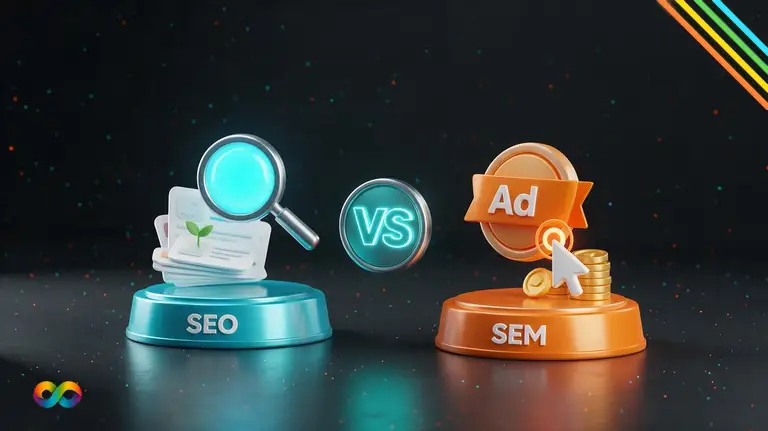

Most business owners I talk to use “SEO” and “SEM” as if they mean the same thing. They don’t, and mixing them up gets expensive. One gets you found for free, slowly. The other puts you at the top of Google this afternoon, for a price, every single click.
Type “dentist Brampton” into your phone. The first few results carry a small Sponsored label. That’s SEM. Below them you might get an AI summary, then a map with three clinics, then the ordinary list of websites. Everything under the ads is SEO territory. Two different games, played on the same page.
I run both for clinics, law firms, restaurants and trades across Ontario, and the question I hear most isn’t “what’s the difference?” It’s “which one do I pay for first?” I’ll answer that properly further down. First, a quick fix on the definitions, because even marketers disagree about what SEM means.
If you only read one paragraph: SEO is the work of earning unpaid rankings in Google. SEM, the way most people use the word today, means buying ads in search results, mostly through Google Ads. SEO is slow and keeps paying off after you stop investing. SEM is fast and switches off the day your budget does. Most businesses that grow end up running both.
SEM means two things, depending on who you ask
Twenty-odd years ago, “search engine marketing” was the catch-all term for any effort to show up in search engines, paid or not. SEO sat inside it. Somewhere along the way the industry narrowed the word down. Today, when an agency, a job posting or a software tool says SEM, they nearly always mean paid search: Google Ads, Microsoft Advertising, ads you pay for by the click.
That’s the meaning I’m using here. If someone insists SEM includes SEO, they aren’t wrong. They’re just using the older definition.
You’ll also run into PPC. That term describes how you pay (per click), not where the ad runs. Facebook ads are PPC. Display banners are PPC. SEM is simply the slice of PPC that lives on search engines. If your real question is paid ads in general versus SEO, I wrote a separate guide on PPC vs SEO and where your first dollar should go.
SEO, in plain terms
SEO is everything you do so Google chooses to show your site higher in the free results. Nobody pays Google for those positions. You earn them, and the work happens in four places.
The first is technical. Can Google crawl your pages, load them quickly on a phone and understand how they connect? One misconfigured redirect or a pile of dead pages can sink a site that’s otherwise great, which is why I put together a full guide to HTTP status codes.
The second is the content itself. Pages that answer what the searcher actually typed, with clear titles and sensible internal links, beat pages written to please an algorithm. Every time.
The third is authority: links from other trusted websites, genuine reviews, and visible expertise from real people.
The fourth matters most if you serve a local area. Your Google Business Profile, your reviews and consistent business details decide who appears in the map results for “near me” searches. My guide to ranking in the Google 3-Pack walks through it.
There’s a newer layer too. AI answers in Google, ChatGPT and Perplexity are built from web pages, and getting cited in them is now part of the job. People call it AEO or GEO, and I unpack the labels in SEO vs AEO vs GEO.
SEM, in plain terms
SEM is renting the top of the page. You choose the searches you want to appear for, write the ads, pick the page people land on, set a budget, and usually pay only when someone clicks. In Canada that mostly means Google Ads, with Microsoft Advertising (Bing, Yahoo and their partners) as a much smaller second option.
Each time someone searches, Google holds a split-second auction among the advertisers who want that search. Your bid matters, but it isn’t the whole story. Google also scores how relevant your ad is and how useful your landing page looks. That’s good news for smaller businesses: a tight, well-built account can outrank a bigger competitor that throws money at a lazy one. The lever is Quality Score, and my Quality Score guide explains how to raise it.
Who wins which spot on the results page
Picture a typical local search, top to bottom. Sponsored text ads come first, and those belong to SEM. An AI Overview may follow, assembled from pages Google decides to cite, which makes it organic. Next comes the map pack, earned through local SEO, although ads can show up there as well. Then the classic blue links, pure SEO. More ads often wait at the very bottom. On product searches you’ll also see Shopping listings, a mix of paid Shopping or Performance Max ads and free listings fed from Merchant Center.
Count those spots. A business doing only one of the two can own part of that page at best. The businesses that dominate a search usually turn up in two or three places at once.
SEO vs SEM, side by side
| SEO | SEM | |
| What you pay for | The work: content, technical fixes, links, local SEO | Each click, plus management |
| Speed | Months to build | Live the day ads are approved |
| When you stop paying | Rankings fade slowly | Traffic stops at once |
| Control | Indirect: Google decides what ranks | Direct: keywords, ads, budget, locations, hours |
| Targeting | Whoever searches the topics you rank for | Precise: radius, schedule, device, audience lists |
| Testing | Slow, weeks per change | Fast, new headlines tested in days |
| Trust | Many searchers skip ads and trust organic results more | Clearly labelled “Sponsored” |
| Who you compete with | Competitors’ content and authority | Competitors’ bids and ad quality |
| Long-term value | Compounds: pages and links keep working | Ends with the budget, though you keep the data |
| Best for | Steady, cheaper leads over time; trust; research searches | Leads now; new businesses; seasonal offers; testing keywords |
What each one costs in Canada
SEO is priced like a retainer. Most Canadian businesses pay somewhere between $1,000 and $5,000 CAD a month for professional SEO, with single-location local businesses near the bottom and national or ecommerce campaigns near the top or past it. I go through the details in SEO Cost in Canada. The part people like: if your rankings double your traffic, Google doesn’t send you a bigger bill.
SEM has two costs stacked on top of each other. There’s what you pay Google for clicks, and there’s what you pay to manage the account, whether that’s an agency fee or your own evenings.
For clicks, WordStream’s 2026 benchmarks looked at 13,474 US search campaigns and landed on a median of $5.42 per click and $66.69 per lead, with a 6.64% click-through rate and an 8.18% conversion rate (WordStream). Use those as a rough compass only. They’re US numbers in US dollars, and Canadian costs swing a lot by city and industry. A legal or furnace repair click can cost several times what a pizza click does. My Google Ads cost guide for Canada has industry ranges.
For management, our own Google Ads service starts at $1,200 a month for ad spend up to $3,000, plus a one-time $500 setup, with a three-month minimum and month to month after that (see pricing).
So which is cheaper? Honestly, that’s the wrong question. SEO is a fixed cost that gets cheaper per lead as rankings climb. SEM is a variable cost that grows with every click. The better question is how soon you need leads, and how long you plan to be in this market.
How fast each one works
Ads can go live the day they’re approved, and the first calls can arrive that same week. What takes longer is getting efficient. Expect two or three months of trimming wasted search terms and testing ads before your cost per lead settles down.
SEO is slower, and I’d rather be blunt about that than sell you a fantasy. Ahrefs found that only 1.74% of newly published pages reached Google’s top 10 within a year for even one keyword, and 72.9% of pages ranking in the top 10 were more than three years old (Ahrefs). Local businesses chasing their own city usually move faster, since the competition is narrower. Even so, three to six months before SEO brings in steady leads is normal.
That gap is the main reason so many businesses run ads while their SEO grows up.
AI Overviews are squeezing both
Google’s AI summaries now sit above a lot of searches, and they pull clicks away from ads and organic listings alike. A few articles claim ads are safe from this. The data says otherwise.
Pew Research Center found people clicked a regular search result 8% of the time when an AI summary appeared, compared with 15% when it didn’t (Pew Research Center). Seer Interactive looked at paid results on informational searches in Q3 2025. Paid click-through rate was 13.88% without an AI Overview and 4.14% with one, for brands that weren’t cited. Organic dropped from 1.45% to 0.52% in the same comparison (Seer Interactive).
There’s a bright spot buried in Seer’s numbers. Brands cited inside the AI Overview earned noticeably higher click-through on both their organic and their paid listings. Seer is careful to call that a correlation, since strong brands tend to get cited and clicked anyway, but it points in a useful direction.
My read: the damage is concentrated on informational searches like “how much does a root canal cost?” Searches with obvious buying intent, like “emergency dentist near me,” still send plenty of clicks to both ads and organic results. So I now write SEO content to rank and to be quoted, and I keep ad budgets pointed at high-intent searches. The citation side is covered in my guide to showing up in Google AI Overviews.
Will running Google Ads help my SEO?
Not directly. Google is plain about it: “Running online ads has no impact on where your website appears in organic search results” (Google Ads Help). Pausing your ads won’t lift your organic rankings either.
The help is indirect, and it’s real. Your search terms report shows exactly which phrases turn into paying customers. Ad tests show which headline people click. And when more people see your name in ads, more of them tend to search for it later. That overlap is the whole reason running both makes sense, which I’ll come back to.
What it looks like with real clients
The Tooth Place, a dental clinic in Bolton, is an SEM story. Between June and August 2026, its Google Search campaigns brought in 219 new patients at $25.87 each. What made it work was unglamorous structure: a separate ad group for every dental service, so someone searching for implants saw an implants ad and landed on an implants page. (Read the case study)
Get Back Physiotherapy in Mississauga is the SEO side of the coin. Content and local SEO work produced 42,000 clicks from 612,000 impressions in Google Search, along with the number one ranking for “best prehab clinic in Mississauga.” Not one of those clicks came with a per-click charge. (Read the case study)
PetCare Partners grew organically to more than 13,600 monthly visitors and took a 51% share of its local category’s search traffic. (Read the case study)
And one that goes beyond search alone: Popular Pizza Royal West in Brampton ran Performance Max, which spreads across Search and Google’s other channels, and got 363 conversions at $1.44 each. (Read the case study)
So which one should you start with?
It depends on where you’re standing. This is roughly how I’d call it for the businesses I meet:
| If you are… | Start with | Because |
| A brand-new business or website | SEM, with SEO foundations from day one | You need leads before rankings exist, and ads reveal which keywords convert |
| An established local business with a decent site | Local SEO, plus targeted SEM for your top services | The map pack and organic results bring cheaper leads over time |
| An online store | Both: Shopping and Performance Max, plus SEO for collections and products | Product searches are crowded with ads and free listings |
| Promoting a seasonal offer or event | SEM | You need visibility for weeks, not years |
| Selling high-value services (legal, renovations, B2B) | Both | Each client justifies the ad cost, and buyers research organically before deciding |
| Working with a very small budget | Local SEO basics: Google Business Profile, reviews, one strong service page | Free or cheap wins come before paying per click |
| In need of leads this month | SEM | SEO simply can’t move that fast |
Still stuck? Ask yourself two things: how soon do I need leads, and how long will I be in this market? A short timeline points to SEM. A long one points to SEO. Most businesses end up answering “both,” just not on day one.
Making them work together
Running both isn’t just double coverage. Done well, each one makes the other cheaper. These are the six ways I combine them for clients:
- I let the ads choose the first SEO keywords. The search terms report shows which phrases actually book appointments, so those phrases get pages first.
- I test headlines in ads, then reuse the winners in SEO titles. Ads answer in days what organic tests take months to answer.
- I run ads where we don’t rank yet and ease off once the organic listing is strong. Carefully, though, because an ad plus an organic listing often wins more total clicks than either one alone.
- I protect the brand name. Competitors are allowed to bid on it, and a cheap brand campaign keeps your own name at the top.
- I retarget organic visitors. People who found you through SEO and left without calling can see your ads later on Google and YouTube.
- I judge both channels by the same numbers: cost per lead and how many leads become customers. Clicks and rankings mean little on their own. My digital marketing KPIs guide lists what to track.
Before you spend a dollar on either
Get the basics in place first: one clear service page per main service, fast on mobile; call, form and booking tracking working in GA4; Google Search Console connected; and a complete Google Business Profile with reviews coming in.
If you’re starting with SEM, keep it small. One campaign for your most profitable service and area, negative keywords from day one, every ad group pointing to a matching page, and a search terms review every week. Most wasted budget I find comes from skipping that last step, along with the other Google Ads mistakes I see again and again.
If you’re starting with SEO, begin with a technical check (indexing, speed, broken links, redirects), then build a keyword map so each page targets one main search and no two pages compete. After that it’s steady work: content that answers real customer questions, and a plan for earning links and reviews every month.
Want SEO and SEM run as one plan?
We handle both under one roof, so your ad data shapes your SEO and your organic rankings bring your ad costs down over time. Take a look at our SEO services, local SEO and Google Search Ads management, or start with a free look at where you stand today.